Please use this form if you would like to have this math solver on your website, free of charge.
Factoring by Grouping
WHAT TO DO:
HOW TO DO IT:
Given a trinomial of type ax2 + bx + c that has
no common factor, where signs may be positive or
negative. Separate the signs from the coefficients.
[Read ± as + or - ]
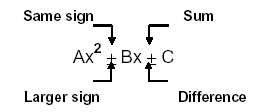
Read the “clues of the signsâ€.
Find product of first and last coefficients.
This is the grouping number (GN)
GN
A·C = P
Find all possible factors of GN = P
whose sum or difference is B
(depending on the sign before C.)
+ sum
or
- difference
P = r·s
, r > s
(r + s) = B
(r - s) = B
Example:
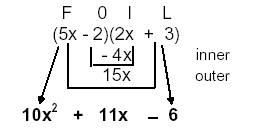
Given: 10x2 + 11x - 6
GN
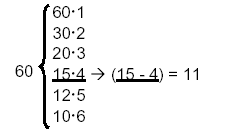
10·6 = 60
The last sign is “−†so find the pair of factors
of 60 that has a difference of 11.
The largest factor of the pair gets middle sign, +
+ 15 and
- 4
The trinomial can be arranged in four terms using
these values as coefficients of x, grouped 2 × 2